The title of this piece is not new. Apart from featuring in the dialogue of Tennessee Williams’ “A Streetcar Named Desire”, the phrase is also the title of a book written by Katrina Kittle in 2006, and of a film released in 2019 (those two aren’t connected in any way other than the title). More than all that, though, it’s certainly a phrase that has been in human consciousness all through human history, as evidenced by the number of examples in the stories and fables of different cultures around the world. (Incidentally – I didn’t know, until I started writing this piece, that there’s a World Kindness Day, observed on the 13th of November each year! Shouldn’t every day be Kindness Day?)
Anyway, to all those stories out there, true or otherwise, let me add one more – a true story.
**The music here is from YouTube. The pictures are not ones from my camera (I couldn’t use that in the wet weather described in the story). I’ve included pictures from the internet, as close as possible to what we had experienced at that time.**
But first – a song to begin with! Remember Glen Campbell? Here he is, with “Try a little Kindness”.
Back to the story:
Sarasi and I went on a road trip (a week in all) to the Sahayadris in July 2014: Hyderabad – Naldurg – Sholapur – Mahabaleshwar – Raigad – Pune and back. It was raining and very foggy in the ghats, at that time of the year, but that added to the adventure of it all! More about that trip in some other post, perhaps, since this post presents a story of the kindness (of strangers) that we were blessed with, during that trip.
The drive from Mahabaleshwar to Raigad was pleasant and smooth. The skies were overcast, and there was a steady drizzle, but there were no signs of impending rain . We covered the distance in about 2 hours, arriving at Shivaji’s fort at Raigad around 4 in the evening. One can’t drive all the way up to the fort. It’s situated atop a craggy hill (thus rendering it, supposedly, difficult to storm and capture). The way up from the base of the hill is either a somewhat arduous 1 hour trek along a forest track, or a ride on the motorised ropeway that the Maharashtra State Tourism Dept operates (every hour or so during lean season).

The modest Travellers’ Bungalow run by the Tourism Dept. is located in the fort itself, so the area around the ropeway terminal has only a few small buildings in a cluster – houses for the Tourism Dept. staff.
There was no specific parking space, so I put our Mahindra Verito under a large pipal tree in the corner of a small field that was left fallow. This meant a five-minute walk to the ropeway terminal. We went there and learnt that the cable car had left a little earlier, and that we would have to wait for about half an hour for the next trip. So, we walked back, placed our overnight needs and a change for the next day in a bag, and sat in the car to wait.
Not even 10 minutes had passed when, in rapid sequence, the skies darkened, there were almost continuous peals of thunder and bolts of lightning, and torrential rain began. It was almost scary. The intense downpour continued for an hour or so and then slowed to a drizzle that didn’t look like stopping, so we decided to head out to the terminal.
I locked the car, slung our bag across my back, and we waded through the now slushy field – this time a ten-minute walk. We got there somewhat wet and soaked in slush up to our ankles.

The cable car ride up to the fort was not as picturesque as it could have been, since there was low cloud obstructing views of the hill and the fort. We disembarked at the top, appreciated the little view the rain allowed, of the fort’s bastions, and hurried to the Travellers’ Bungalow ‘complex’. Thankfully, there were rooms available, and we got one with the caretaker’s assurance that there would be hot water in the bathroom. He also told us what vegetarian fare his wife would prepare, and offered to send our dinner to our cabin so that we wouldn’t have to come to the dining hall in the rain.

So, a hot bath followed by a hot meal, and we were ready to get to bed. There was a TV set but the only channel it was tuned to was Marathi DD – so we were able to watch a bit of Marathi Chitrahaar. We enjoyed that for about half an hour till around 8 when the skies opened up again, with accompanying sound and light. The power went off. The two of us lay in the dark, using the torches on our phones (the old keypad ones) occasionally. We unpacked various memories of storms we’d experienced. We also recalled movies featuring storms, especially Anokhi Raat, the classic 1968 B/W film featuring Sanjeev Kumar and Zaheeda in a story, (all in one stormy night) of strangers (a lady traveller and a bandit), stranded in a travellers’ bungalow.
For those who remember the film (and for those who don’t) here’s a clip with the unforgettable song “Taal mile nadi ki jal mein”:
The rain let up in the early hours of the morning, slowing to a drizzle. This allowed us to venture out for breakfast. Then, armed with umbrellas (lent to us, very kindly, by the caretaker), we found a guide to take us around the fort. He was such a find – an unconsciously chauvinistic Maratha, whose narration of the stories of Shivaji and the fort, compensated, totally, for the gloomy and wet weather. (He said his name was Sambhu, and proudly explained that it was short for Sambhaji, the name of Shivaji’s eldest son).
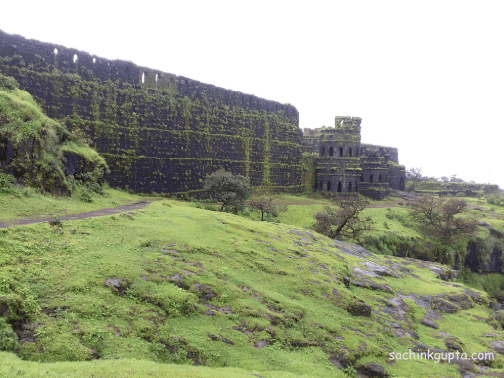
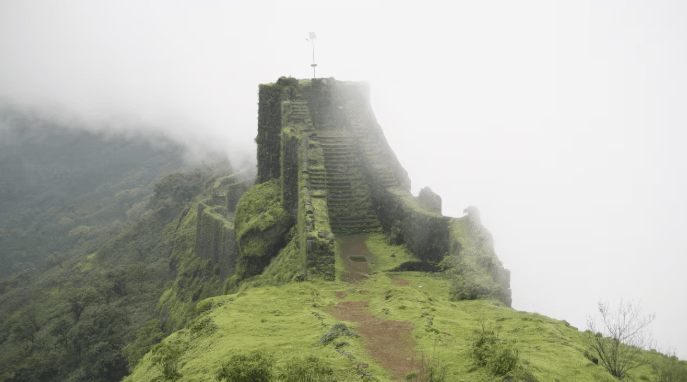
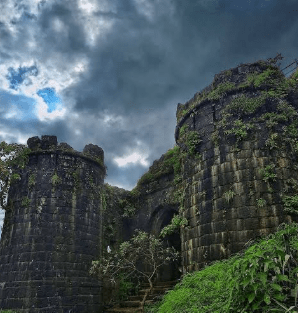
Our jaunt around the fort took till lunchtime. After another hot meal prepared by the caretaker’s kindly wife, we returned their umbrellas, packed up, and bid them goodbye.
We took the cable car down and waded, once again, through the slush, to the car. We looked up the road map we had with us, to confirm our route to Pune, fastened our seat belts, and I turned the ignition key….
….. to NOTHING. Nothing fired, nothing turned, nothing lit up on the dashboard, nothing made even the slightest sound. All we experienced was deafening silence. Prayers didn’t help (neither my muttered ones, nor Sarasi’s fervent appeals) when we tried the key again and again. And we now experienced the sinking feeling that followed the realisation that our battery had chosen the worst (or best, if it was a test) time, weather, and location, to die.
The drizzle had begun again. I covered my head with a plastic bag and went over to the operator at the ropeway terminal to ask about a mechanic or a workshop in the vicinity. He told me that the closest was a tractor mechanic’s place at Pachad, about 3 km away, and suggested that I could wait for some vehicle to come by so that I could hitch a ride.
Sure enough, a vehicle did come by, half an hour later. It was a rural ‘taxi’, a beat up Force Trax Toofan, meant to carry 9 human passengers and as many non-human passengers as could be packed in as cargo. After the entire complement of passengers had disembarked, I met the driver and his sidekick (a k a ‘helper’) to ask for a ride. The combined ages of the two wouldn’t have been more than 45. Both were sporting wispy moustaches that, quite amazingly, made them look younger than they probably were.
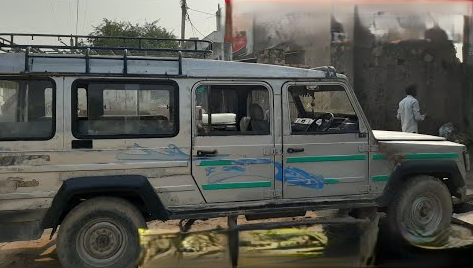
Anyway, on hearing of our predicament, the driver said “It’s only that the vehicle won’t self-start isn’t it? Don’t worry, we’ll push start it!”
So, with Sarasi at the wheel, we pushed the Verito out of the slushy field, onto the road, which, even though pitted and potholed, was firm underfoot. By this time, the drizzle had been replaced by steady rain. Nevertheless, these two worthies didn’t stop. First, they gave me a crash course on push starts: “Put it in 2nd, leave the ignition on, release the clutch when we have some momentum going, and DON’T let it stall once it fires and starts”. They were so well-meaning, I didn’t have the heart to tell them that I’d developed those skills in abundance well before either of them was born! Then, with me in the drivers’s seat (literally, but not yet metaphorically) they put their shoulders to the stern and their backs to the task. I followed all steps (mine and theirs) to perfection, but the engine didn’t fire, not even in the slightest. Four tries later we arrived at the obvious conclusion: the battery was as dead as the last dino! We were puzzled however, since a push start should have worked even with such a battery.
We didn’t know then (and I came to learn much later) that push starts don’t work with a dead battery if the vehicle has an electronic injection system, which needs at least a modicum of power to kick in.
Our attempts being of no avail, I broached the topic, once again, of a ride to the nearest workshop. But they wouldn’t hear of it. “We’ll start it with our battery,” they said. Drenched though they were, they rooted around in the scrap heap at the ropeway terminal, and came back with big grins on their faces, and two bits of what must have once been wiring for lights in some ancient shack. It seemed, to me, that the ‘wire’ would not survive the ordeal of conducting an electric charge from one battery to the other. But not so to our Good Samaritans! They were absolutely confident that they would get our car going.
They drove their van up and positioned it on the passenger side of the Verito. While the helper held up a plastic sheet to cover both bonnets (it was still raining steadily), the driver started to connect the two batteries. My offer to assist was politely declined. “You sit at the wheel, with the gearshift in Neutral, and both of you please put your seatbelts on,” he said. “When I have the batteries connected, I’ll give you the word and you try starting. The engine will surely fire. Once it does, I’ll disconnect and close your bonnet. You please take off, just take off! Don’t wait, that would be a risk.”
I got in, rolled my window down a little so that I could hear him, and gripped the ignition key. We waited with bated breath, fingers and toes crossed, and hearts racing. Sarasi pulled a 500 buck note out of her bag and asked me to give it to them. I couldn’t just then, because they were both in the front of the car. On the call, I turned the key, and the engine caught, instantly! The bonnet came down. They moved aside, with sheet and wires in hand, and waved us forward with urgency, screaming “Go! Just go!” They were both soaked to the skin, but they were beaming. I rolled down the window to give them the 500 note, but they didn’t step forward. “Don’t stop,” they yelled. “Just go!” “Thank you so much! You’ve been so helpful! Please take this with our thanks,” we requested. “Your blessings are more than enough,” they replied. “Just go, and DO NOT take your foot off the gas until you get to a battery service place!”
So that’s just what we did! We took off! I watched them in the rearview mirror. They stayed on the road, in the rain, hands on their hips, until we took the bend in the road. With that, they moved into our past.
It’s been 10 years since then. Even so, that last sight of them is now a picture permanently imprinted in our memories. Absolutely unforgettable, those guys! Two rural youngsters, total strangers, totally selfless, who chanced upon us that day and stepped up just because they wanted to help in any way they could, with no thought of anything reciprocal.
These are the things in life that leave you speechless. No words suffice.
There is an epilogue to the story, in another act of kindness:
We kept going at a steady pace for about 8 km before we turned onto the highway to Pune. In another 3 km or so we were passing through a village when we spotted a battery service place. We pulled in there. I let the car idle, just in case switching off would leave us stranded again. I walked into the workshop and explained things to the owner. He came out and asked me to switch off, assuring me that he would get it restarted, one way or another. He checked the battery with his equipment and told me that we were very lucky to have been able to get the car going at all, because the battery had failed, totally. It was stone dead. The 12 km drive had not resulted in the slightest accumulation of charge.
So we bought a new battery from him. He was not equipped to accept card payments, and the cash I was carrying wouldn’t have sufficed. He asked if I could draw cash from an ATM, and told me there was an SBI ATM in the next village down the road, about 5 km away. I asked Sarasi to wait at his workshop while I drove over to the ATM and back with the cash. But he would have none of that. He didn’t want us to take the trouble of coming back . He said his relative had a little store next to the ATM. He gave me a chit with the relative’s name and the amount of payment for the battery. He asked me to draw cash, leave the required amount with that gent, and to resume our journey ‘happily’.
Trust, personified!
We were the beneficiaries of two significant acts of kindness that day (although of entirely different types), reinforcing our belief that there is essential goodness in most people.
Why are we seeing fewer demonstrations of this goodness than we used to? And why, when it is demonstrated, does this seem to be more in rural areas and small towns than in the larger places? Perhaps, with the gradual but ceaseless changes in the ways in we conduct our lives and our relationships, we are paying less attention to other people, and more to ourselves and those in our immediate circles. Perhaps we tell ourselves that our resources are limited and it is our responsibility to care first for our own before we think of others. But, while this may be true of material resources, is it true of concern and kindness? Are these not resources that are limitless, that we can produce at will, at any time and place of our choosing? And, while time is a limited resource, are we really using it all in the care of our own? Do we really have none to spare for others?
The capacity to care for others is, in my opinion, very much like other human capacities, in that, the more we use it, the less hesitant we are to use it, and the less we use it, the more dormant or distant it becomes.
Each one of us has had points in our lives where we did care, and were concerned, beyond considering only ourselves. For some the points may be far back in time, for some they may be recent. Whichever of those categories we may belong to, it is surely possible to rewind, to recall how we were and how we went about our lives and relationships, and to recover what we’ve let go of.
Perhaps this song from Donovan, ‘People Used To’, may help us get started on our way back !
 nothing too loose